Development
Laravel Tools
The Laravel stack, tools, and learning resources I actually use to build, deploy, and ship applications.
Use the controls to zoom in on the diagram, then scroll to explore the details.
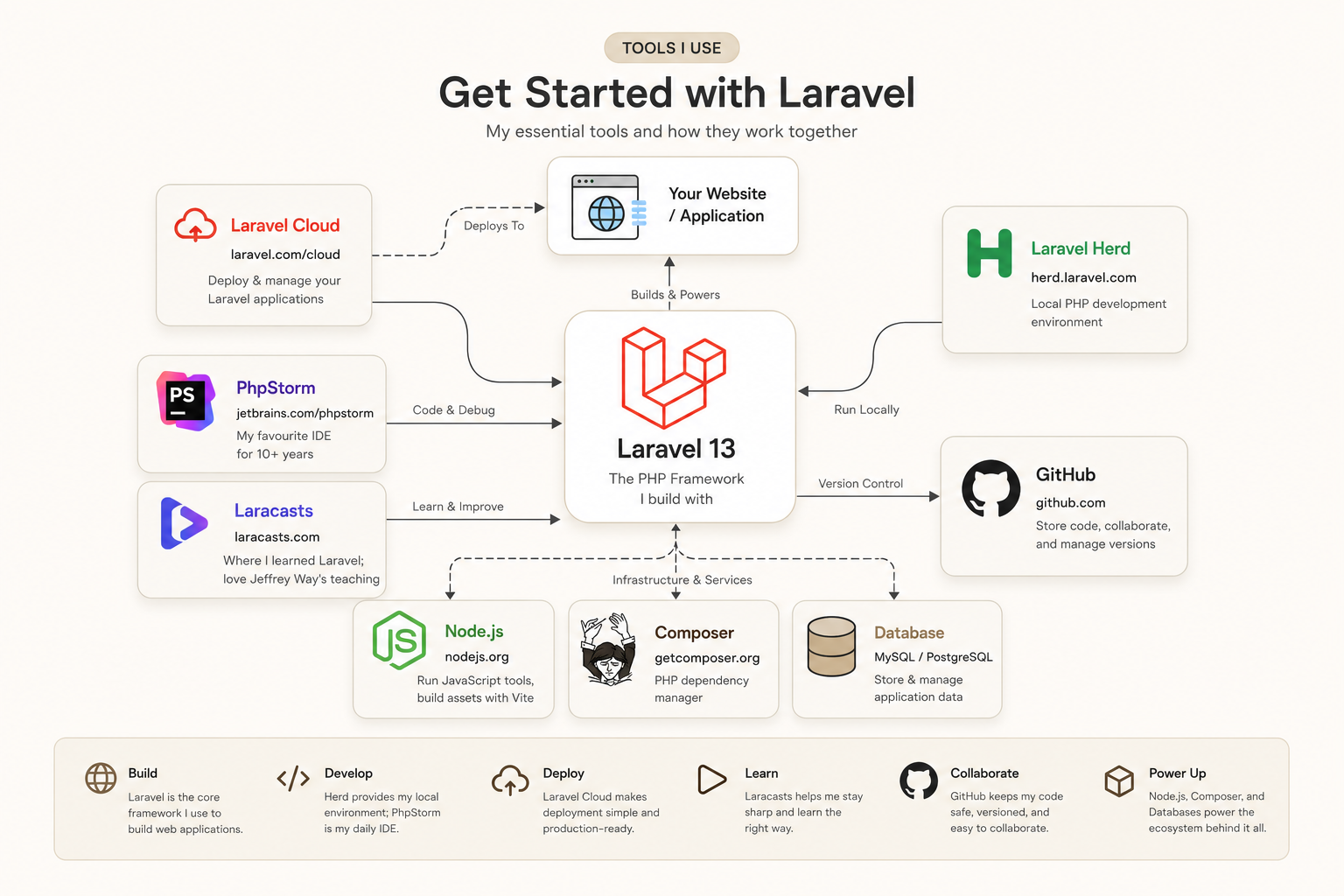
Laravel remains the framework I return to because it balances structure, speed, and readability without making the work feel heavy.
I work with the latest Laravel release — currently Laravel 13 — and I keep the stack around it intentionally small. These are the tools I rely on every week, not a wishlist of things I might try someday.
Laravel is where I start. The documentation is excellent, the conventions are thoughtful, and the ecosystem gives you routing, queues, authentication, validation, and more without turning every project into a custom framework. I revisit the docs often — not because I forget Laravel, but because good conventions are worth re-reading before a codebase drifts too far from them.
I deploy my websites on Laravel Cloud. It removes most of the server-management noise: connect your repository, configure environments, and ship without spending your week on infrastructure instead of the product. For the kind of Laravel work I do, that simplicity is worth a lot.
I run my PHP development environment with Laravel Herd. Setup stays quiet, switching PHP versions is straightforward, and I can focus on the application instead of wrestling with configuration every time I open a project.
PhpStorm has been my favourite IDE for over ten years. Navigation, refactoring, debugging, and Laravel-aware tooling are all strong enough that I rarely fight the editor — which matters when you are trying to hold a whole application in your head.
Most of my Laravel knowledge came from Laracasts. I love Jeffrey Way — he teaches in the simplest way possible, and the best part is when he explains the magic behind Laravel instead of treating it like a black box. The other instructors are excellent too, but Jeffrey set the tone for how I think about the framework.
To stay current, I follow Laravel News on Telegram. It is where I catch updates on what is new in Laravel and which packages have been released — quick signals without drowning in noise.
GitHub is where I store my code. Version control is not optional for me; it is how I collaborate, review changes, and keep a clear history of how an application evolved.
A few smaller habits and tools stay close too: Laravel Pint for consistent formatting, Pest for readable tests, and first-party Laravel packages before reaching for abstraction for its own sake.
This page will grow over time, but the standard stays the same: only tools that earn their place through repeated usefulness belong here.